Showing posts with label Books. Show all posts

Tuesday, 4 March 2014

Book Review: "Threat Modeling: Designing For Security"

Ben Rothke reviews Adam Shostack's new book:
"When it comes to measuring and communicating threats, perhaps the most ineffective example in recent memory was the Homeland Security Advisory System; which was a color-coded terrorism threat advisory scale. The system was rushed into use and its output of colors was not clear or intuitive. What exactly was the difference between levels such as high, guarded and elevated? From a threat perspective, which color was more severe — yellow or orange? Former DHS chairman Janet Napolitano even admitted that the color-coded system presented 'little practical information' to the public. While the DHS has never really provided meaningful threat levels, in Threat Modeling: Designing for Security, author Adam Shostack has done a remarkable job in detailing an approach that is both achievable and functional. More importantly, he details a system where organizations can obtain meaningful and actionable information, rather than vague color charts."
Full review:
http://books-beta.slashdot.org/story/14/03/02/1748257/book-review-threat-modeling-designing-for-security
Adam Shostack
Threat Modeling: Designing for Security
John Wiley & Sons
17 February 2014
ISBN-10: 1118809998
ISBN-13: 978-1118809990

Thursday, 21 February 2013

The Raven that Refused to Sing

and other stories

Prolificacy's name is Steven Wilson, as you might agree when you've seen the man's 500-page discog here.

Each new Steven Wilson album release is a bigger, fuller, more satisfying art-event than its predecessor. I'm talking of course about the limited deluxe editions. Nothing else is worth having, if you can have instead one of these wondrous objects, while nothing else - no mere collection of tunes and songs - is in our time, worth our time reviewing. Obviously then, it's especially edifying when - reportedly to beat an internet leak - your preorder arrives, entirely unexpectedly, four days early.

Rivaling the dimensions and heft of some paving slabs, well the 10" ones anyway, these special editions seem to have evolved by a process of continuous improvement into a format which by now should make the fan relax immediately into the familiar luxurious form, simultaneously with the unfailingly new and truly multimedia content. It's like a lottery win of the senses. For consider:

First, it looks and feels great - a solidly substantial objet d'art, with its great 5mm thick hardbound book cover enveloping 128 heavy and glossy illustrated pages full of impressions, stories, lyrics, sleeve notes, mysteries. Next, you get the smell of it, obviously the high aromas of a newly printed, full gloss inky tome. Only at the end of these sensory introductions, and as a final formality, will you eventually get to hear it. Before then, this beautiful thing has already carved its little square snug into your world, and as you begin your first consumption of these sounds (2 CDs) and visions (a DVD and a Blu-Ray), you reflect that Steven could easily have achieved a full sweep of all five senses, by the simple expedient of including a stick of chewing gum. Maybe next time.

The Musicians

Every work of this standard of quality, and each major aspect of such a work, is essentially in itself a collaboration. The original and most vital aspect here being of course the music, that collaboration comprises primarily Steven himself, singing and playing various keyboards (including King Crimson's original mellotron, borrowed from his friend Robert Fripp) and guitars, as befits a solo album. Thence in the astonishing ensemble of legends that is his touring band, alphabetically we have Nick Beggs on bass, Chapman Stick and vocals; Guthrie Govan on lead guitar, and Adam Holzman on keyboards; while Marco Minnemann* hits stuff, and Theo Travis blows into things.

Oh, and Steven's choice of associate producer / recording engineer? Only bloody Alan Parsons.

The Music

The album comprises six pieces, with three of these - satisfyingly enough, for those with an adult's attention span - each being over 10 minutes long. It opens with a song previously released on Steven's earlier live document, the quite recent Get All You Deserve 2CD / DVD / Blu-Ray.


1. Luminol: an uptempo percussive 4-to-the-floor with driving bass, signals the initial intent. Transitioned by Theo's flute and harmony vox / mellotron, it falls and fragments into a typically prog clipped and snipped timesig, before slowing and softening into the story of the busker (one of Steven's ghost stories), with yet more lush harmonies. There are hints of and nods to a shared progressive jazz heritage throughout, culminating in a typically strong KC and mellotron restart and return to quick tempo for the finish. From Wikipedia:
"Luminol", which was first performed by Steven Wilson and his band on the second half of his Grace for Drowning tour, takes its inspiration from a busker, who, according to Wilson, is "there every single day. It doesn’t matter what the weather is like; he’s always there, playing his acoustic guitar and singing these songs. Snow, rain, gale force wind – nothing will stop him from being in his spot. ... He’s the kind of guy who is so set in his routine that even death wouldn’t stop him." Wilson considers the notion "that somebody could be a ghost in life, as well as a ghost in death, somebody who’s completely ignored even in their lifetime – it hardly makes a difference; and death doesn’t make a difference, either; it doesn’t break the routine." [1]
2. Drive Home is soft and gently acoustic, showcasing Steven's famous talent for hook laden tune smithery. You need to clear away all the jetsam in your brain and face the truth. Even this gentility itself takes a percussion break, a breather wherein for example a delicate guitar part ambles alone for a few bars. Builds to a mixed (both climactic and anticlimactic) finish.
"Drive Home" is based on a suggestion from illustrator Hajo Mueller. It is "about a couple driving along in a car at night, very much in love; the guy is driving, and his partner – his wife or girlfriend or whoever she is – is in the passenger seat, and the next minute she’s gone." The ghost of the man's partner eventually returns, "saying, ‘I’m going to remind you now what happened that night.’ There was a terrible car accident, and she died, etcetera, etcetera – again, the idea of trauma leading to a missing part of this guy’s life. He can’t deal with the reality of what happened, so he blocks it out – like taking a piece of tape and editing a big chunk out of it." [2]
3. The Holy Drinker indulges a sequence of guitar / keyboard / clarinet solos as well as some welcome overdrumming in its satisfyingly extended (2½ minute) 4/4 introduction, prior to leading into another SW ballad, whose verses are similarly separated by inventive instrumental fills. The middle duet between Fender Rhodes and flute, leading into some big Keith Emerson chops, is particularly worth the ticket price. When the story continues in a lente pianissimo section, its dramatic and mathematical conclusion can be sensed from afar.
According to Wilson, "The Holy Drinker" concerns "a guy who’s very pious, very religious, preachy and self-righteous. I’m thinking of TV evangelist-types – guys who are prepared to tell people that they’re living their lives wrong and that they’re missing something because they don’t believe in God or whatever it is." The man, who, despite criticising other people's lifestyles, is himself an alcoholic, unwittingly challenges the Devil to a drinking competition, with disastrous consequences: "Of course, you can’t beat the Devil at a drinking competition – you can’t beat the Devil at anything – and so he loses. ... He gets dragged to Hell." [3]
4. Vocally, The Pin Drop starts unpromisingly. But instrumentally, this is a consistently strong and driving track, with particularly tortured sax.
"The Pin Drop" addresses "the concept that you can be with someone because it’s comfortable and convenient, not because there’s any love or empathy." Wilson explains that "The song is basically sung by the wife. She’s dead, she’s been thrown in the river by the husband, and she’s floating down in the river while singing this song – from beyond death, beyond the grave, as it were." The song considers "The idea... that sometimes in a relationship there can be so much tension, so much unspoken resentment and hatred, that the tiniest thing can set off a violent episode, and in this case, one that ends in tragedy. The sound of a pin dropping on a floor can be the thing that instigates the fury." [4]
5. Back now in time and context to Foxtrot era Genesis, for the introduction to the little proggy masterpiece that is The Watchmaker. Not a love song, but a tale of touching companionship and failure, human existence, inevitability and frailty. Its second act warms and beats to the musical imagery of clockwork, accelerating subjectively through a spectacular clarinet and guitar duet, before a braking return to the piano-backed, heart-rendingly honest narrative. The endgame, by turns instrumental and vocal, is a particularly pleasing and quirky workout.
The fifth track on the album explores "the story of the watchmaker, the guy who is meticulous about his craft, but he never has any kind of emotional outburst, nor does he express violence or any extreme emotions whatsoever." It concerns "a couple who have been together for 50 years or more, purely because it was convenient and comfortable." Wilson explains that "The watchmaker ends up killing his wife and burying her under the floorboards of his workshop. But, of course, she comes back, because she’s been with him for 50 years; she’s not going to leave him now." The song concludes when "the wife comes back to take him with her, which", Wilson suggests, "is another classic ghost story, in a way." [5]
6. As for the closing, title track: The Raven that Refused to Sing is perhaps the most chillingly haunting ballad on this quite haunty album.
The title track explores the story of "an old man at the end of his life who is waiting to die. He thinks back to a time in his childhood when he was incredibly close to his older sister. She was everything to him, and he was everything to her. Unfortunately, she died when they were both very young." The man becomes convinced that a raven, who visits the man's garden, is something of "a symbol or a manifestation of his sister. The thing is, his sister would sing to him whenever he was afraid or insecure, and it was a calming influence on him. In his ignorance, he decides that if he can get the raven to sing to him, it will be the final proof that this is, in fact, his sister who has come back to take him with her to the next life." [6]
See and hear for yourself:


The six indented comments above, quoted from Wikipedia, are in fact primarily sourced from a particularly illuminating interview with Steven (appearing two weeks ago in musicradar) in which he talks about the initial development of the project, and discusses the background to each song in turn and in generous detail.

The Bonuses

The second CD contains different versions of all of the main songs, curiously labelled "(demo)" - who on earth would demand a demo from an effective supergroup** like this? - together with one "unused idea", Clock Song. Were the pendulum percussion and the musical chimes regarded as too obvious, too Mellotron Scratch? Maybe it just couldn't be bent to inhabit the overarching and otherwise cohesive supernatural / ghost story / fear of mortality / end-of-life regret concept circle of the piece. Whatever the reason, it is indeed little more than a not-fully-developed idea, inessential, though not unpleasant.

The documentary DVD and Blu-Ray (see below) also contain between them:
  • a 96/24 Stereo LPCM of the album;
  • one bonus track - Drive Home - lounge version, also 96/24 Stereo LPCM;
  • instrumental versions of all the album tracks (96/24 Stereo LPCM);
and as you would expect from the progressive world's most prolific 5.1 remastereer, the following 5.1 mixes:
  • DTS 96/24 5.1 surround
  • Dolby AC3 5.1 surround
  • 96/24 5.1 LPCM
  • DTS-HD Master Audio 5.1
YMMV

One reviewer, while describing this new album as painful, moving, desperate, melancholic and superbly beautiful and exhorting us to Buy it, also advises, It’s pretty much a progressive affair. As simple as that. There is nothing here that manages to stretch itself out of the canons of such a well-defined genre. And he may be right; but many long-time fans of Steven Wilson (and of Porcupine Tree in particular) are impressed by the jazz sensibility and free-form styling that have infected his recent work - perhaps inevitably, given the creative cadre of influences here, and his own experiences in remastering those King Crimson, Jethro Tull et al masterpieces for surround audio. To those fans, this kind of prog is new and fresh today, forever heading off in unexpected directions.

The Stories and their Art - Hajo Mueller

While Steven himself provides the quite literally haunting stories for Luminol and The Birthday Party, collaborator Hajo Mueller supplies the concept and illustrations throughout the book, as well as the original idea for the title story which he then reworked with Steven. Both the DVD and the Blu-Ray include his art gallery.

Photography & Documentary - Lasse Hoile

It wouldn't be a new Steven Wilson opus without that final contribution from his long and fruitful collaboration with Lasse Hoile, who here provides for both the DVD and the Blu-Ray, the photographs used in the photo gallery, as well as filming and editing the indispensable studio documentary.

The Gig

Fellow Weegies, let's all catch the touring band at Glasgow's ABC this March 2nd. Update: Oh wait...
* Zappa alumnus supreme Chad Wackerman (Best Drummer Name Ever!) stands in for Marco Minnemann on the North and South American legs of the current tour.
** Actually, each member leads his own band. Hypergroup, then?

Thursday, 26 July 2012

RIP Free Cellular Web Access

And A Mystery Solved Thanks To XKCD

My original Amazon Kindle, with its free global access to 3G networks and its experimental browser, was a Christmas gift from my wife, having been inspired by my apparent inability to organise my dead tree storage. This browser uses the same connection that all 3G-equipped Kindles use to download books via Amazon's Whispernet, and until recently, it offered access to as much of the world wide web as you could take. Usually, that wasn't much. The browser renders like treacle, while pages don't look terrific on the monochrome, electronic ink display.

But it was functional, and quite useful on continental holidays and other occasions when we found ourselves temporarily without WiFi access. Just as recently as, well, earlier this very month, I had cause to be grateful for Linda's decisions (-; in both cases, against my better judgement ;-) to buy me (a) a Kindle, (b) with 3G connectivity. Sitting in the garden outside our French gîte, I reached the end of my chosen holiday read (a pulpwood edition of The Hunger Games) and wanted immediately to download its sequels, whilst simultaneously checking out a few blog updates.

That was then. Today, as I read on El Reg, Amazon have started exercising their reserved, small-print right, to throttle this free 3G access at just 50MB per month. Obviously having learned from both the Sony experience and their own previous missteps, they are following this course in preference to just switching off free 3G access altogether.

However...

There still remains a mystery in the detail. This post on the MobileRead forum reports the cutoff message, followed by another:
I got a second message saying that I'd have 24 hours of grace to continue to use 3G for Web browsing, but that after that I could use 3G only for visiting Amazon.com, Wikipedia, and the Kindle Store.
Certainly, retaining free access to both Amazon and the Kindle Store makes commercial sense. But why should Wikipedia be particularly exempted?

That's when I remembered the above XKCD cartoon, from 3½ years ago. Click through for the full version. Although the answer isn't in the printed cartoon itself, it's in Randall Munroe's floating text that appears when you hover over it:
I'm happy with my Kindle 2 so far, but if they cut off the free Wikipedia browsing, I plan to show up drunk on Jeff Bezos's lawn and refuse to leave.

Wednesday, 25 July 2012

Book Review: Liars & Outliers

Enabling the Trust that Society Needs to Thrive

A favourite blog was noticeably subdued of late, while the inestimable Bruce Schneier put his finishing touches to his latest tome. No sooner was he done, however, than all of my favourite blogs burst out with news, reviews, and other expositions about it. Resolved to buy a copy, maybe on Kindle, I nevertheless put in a book request to my manager, and was in due course pleasantly surprised by the hardback landing on my desk.

Surprised? Well, I was unsure whether it would qualify for purchase. It's not a technical book, although it does cover many technical issues we have to deal with in daily business. It's not about programming, or not exclusively so. What it is, is a thorough investigation into the nature of trust within society. Or in other words, into the nature of of civilisation: how it works, and why it doesn't. How indispensable and deeply reaching is trust. How, why, when and where we depend upon it. How our essential systems can be designed to guarantee it. As ever, Bruce's approach to each little corner of the subject matter is almost rigorously scientific, being relatively free from hand waving and equivocation, and as evidence-based as he can diligently achieve.

After an overview, declaring the primary aims of the book, and containing an excellent diagram of the formal terms used (societal dilemma being a central one) and their relationships, the remainder of the book consists of four main sections.

Part I: The Science of Trust

This deals with the various research fields comprising the "background" sciences of the book: experimental and evolutionary psychology, biology, neuroscience, economics, the mathematics of game theory, computer security, and so on. Chapter three will be particularly familiar territory if you've ever studied evolutionary perspectives on behaviour, such as sociobiology. This is followed by a historical view of sociology and societal scaling, then by a return to game theory for an examination of societal dilemmas and the nature of conflict.

Part II: A Model of Trust

This is the most intensely argued and analytically comprehensive section of the book, and it might take more than one reading here and there to follow the workings of the "Model" presented. Clearly this is an exposition of the central concept that inspired the whole work. Various pressures are considered both in isolation and in concert: moral and institutional stresses, considerations of reputation, and the limits imposed by security systems. Schneier's goal is to get you to hold all of these simultaneously in your conception, tracing the interconnections and interplay between them.

In chapter 9, Institutional Pressures, Schneier examines the threats facing modern society. Acknowledging that one of the biggest perceived threats is terrorism, he astutely reminds us we can never ensure perfect security against this. Arguing that America's TSA budget should be measured in the millions, not billions of dollars, he observes that talk of terrorism as an "existential threat" to society is complete rubbish. While terrorism remains sufficiently rare, which it is; and while the vast majority of people survive, which they do; society itself will continue to survive. Yet while this observation remains unarguable, politically it is impossible for our leaders to speak it.

Part III: The Real World

In the second half of the book Schneier describes real world Organisations, Corporations and Institutions, illustrating how the competing interests of these bodies lead to evolution and resolution in certain real world situations. A recurring theme is fishing, which at all levels has rules and quotas adhered to by the majority, but offering considerable profits and a low risk of getting caught to the minority of cheats.

Part IV: Conclusions

To be frank, you could say that there are very few actual conclusions in the book itself. In the chapter on Technology, Schneier proposes a set of design principles for effective societal pressures, one of the key points of the book. But more often, he provides us rather with information, with the background to understand and make sense of that information, and with the grounding in a refreshing number of academic and scientific disciplines that we can exploit to build confidence in our own conclusions, which we are encouraged to reach independently.

In so doing, you're certain find the scope of input presented here quite breathtaking.

Bruce Schneier
Liars and Outliers: Enabling the Trust That Society Needs to Thrive
John Wiley & Sons
17 Feb 2012
ISBN-10: 1118143302
ISBN-13: 978-1118143308

Monday, 30 April 2012

My Work in Print: 1987

Previously: 1985

DISZ80 - a Z80 Disassembler

Delighted today, to receive a comment from Geoff Wearmouth on that previous Personal Computer World: Sub Set article. Geoff it was, who first typed my 1094-byte Z80 disassembler DISZ80 into a Sinclair Spectrum some quarter century ago. His site http://www.wearmouth.demon.co.uk/ gathers Sinclair ZX Spectrum ROMs, as well as emulation tools for the related ZX80, ZX81, and the eternally awe-inducing Jupiter Cantab Ace.

Geoff's own Spectrum Globeplotter, featured in The Register Hardware's Basic Instinct last week, and itself more than a quarter century old, proves us to be PCW stablemates. Whilst presented as a BASIC listing, this spinning-sphere-transpoising, sinusoidal-Mercator-projecting screen plotter actually employs untold amounts of custom crafted machine code.

Some ten years ago, Geoff made appeals in comp.sys.sinclair for any further information about PCW back issues. And just today, Stephen Parry-Thomas of http://jupiter-ace.co.uk/ has replied, with full scans of Sub Set from February-May 1987. At last, the extensive line comments can be restored to my crusty old utility!

February 1987

Click to big. In "Z80 Radix Conversion" David Barrow starts off with CONVHL, which is used at various points within the main disassembler to convert 16-bit integers to various bases (binary, octal, decimal, hex) for readable output. He remarks upon the "quite ingenious" optimised method used to convert raw digits to ASCII.

I remember being quite happy with the way David had split out the various modular components of the program. Publishing these in multiple datasheets over several months resulted in a steady stream of payments, giving a pleasant illusion of gainfully paid employment!

March 1987

March saw the publication of routine XTRACT, designed to read and print strings from a table. As David correctly notes, this too is pathologically storage space optimised, for both code and data table size.

April 1987

The I/O fest continued in April with a set of five connected utilities dealing with the output of hex data and addresses. This is the point at which David, having correctly diagnosed my space optimisation compulsion, shows where I could have saved one program byte, two stack bytes and 14 clock cycles. Though 25 years later I've still to validate the assertion, respect for David's manifest expertise compels me to believe it, albeit truculently.

May 1987

The May edition was given over to just the two remaining big routines, spread across five new datasheets / appendices, and completing the 1094-byte Z80 disassembler.

So, once again: hooge thanks to the guys, Geoff Wearmouth and Stephen Parry-Thomas, who got these page scans to me - I do hope you'll both understand and forgive the indecent haste with which I've posted them here.

Try It Out!

Finally, Geoff's just been in touch again to tell me that DISZ80 is actually live online, and has been for years, embedded in his ZX Spectrum Emulator. How cool is that? Click here to run it. I just tried it out using Internet Explorer 8, 64-bit (!) version. Click the "screen" then press Enter for instructions. The Disassembler itself can be disassembled (!!) by typing the address $5100 then pressing Enter. The code you see starting at that address is actually the DISZ80 entry point, as illustrated in the first of the May 1987 pages above. Mind = Blown!

Thursday, 5 January 2012

Scattered Along the River of Heaven

A Happy New Year to everyone who's currently using the same calendar as me.

Here's a great short to kindle your new year, new found, interest in Science Fiction. Aliette de Bodard is an American born, Franco-Vietnamese author and defence video analyst who lives in Paris. She has a strong interest in ancient Aztec, Vietnamese and Chinese cultures. This piece, based on four original poems in ancient Chinese (Qing and Tang) styles, is one of those stories you start re-reading immediately upon finishing it:

Saturday, 5 November 2011

My Work in Print: 1985

I've previously written about the very competitive crafting of optimum machine code programs for Personal Computer World magazine's 1980s Sub Set series, here and there. In 1985, the incumbent series editor David Barrow convinced Century Communications to publish two books of the best submissions. According to the descriptions on their publication history pages, these books were "Edited and produced working directly from the author's word-processor by NWL Editorial Services, Rushley, High Ham, Somerset" - a huge novelty in the publishing world at the time. Book geeks: note the cool adjacent ISBNs!

Best of PCW Assembler Routines for the Z80

Although the first IBM PC with its 8-bit Intel 8088 chip had already been available for about four years, still most business software was based on the CP/M operating system, and the more powerful, backward compatible Zilog Z80. Joined to legion Sinclair hobbyists, these users constituted quite an army. Here is the index of my contributions to the Z80 edition:
  • ECAL - Calculate error correction byte; pp. 70-71.
  • EFIX - Validate data with error correction byte; pp. 71-72.
  • NEWPC - Anticipate PC contents after next instruction; pp. 78-82.
  • RDM32 - 32-bit pseudo-random number generator; pp. 147-149.
  • SQR31 - Square root of 32-bit signed (positive) value; pp. 169-170.
  • SQR32 - Square root of 32-bit unsigned (absolute) value; pp. 169-170.
  • CURT16 - Cube Root of a 16-bit unsigned integer value; pp. 170-174.
  • CURT32 - Cube Root of a 32-bit unsigned integer value; pp. 174-176.
  • SDIV4 - 4-byte signed integer division; pp. 183-185.
Barrow, David (editor)
Best of Personal Computer World Assembler Routines for the Z-80
Century Communications Ltd
1985
ISBN 0 7126 0506 1

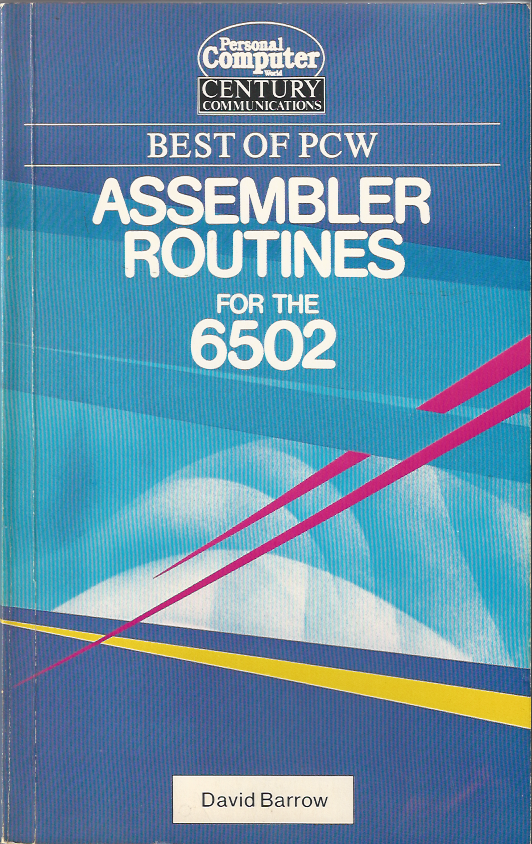
Best of PCW Assembler Routines for the 6502

While businessmen cycled their Z80s, many hobbyists with an aversion to dead-flesh rubber keyboards were devouring Commodore VIC-20s and 64s, and Acorn's BBC Micro. All of these used the MOS Technology 6502 processor. Here is the index of my contributions to the 6502 edition:
  • RINXY - Register Indirect addressing mode emulator; pp. 20-22.
  • ECAL - Calculate error correction byte; pp. 88-90.
  • EFIX - Validate data with error correction byte; pp. 90-91.
  • SQR15 - Square root of 16-bit signed (positive) value; pp. 125-127.
  • SQR16 - Square root of 16-bit unsigned (absolute) value; pp. 125-127.
  • SQR31 - Square root of 32-bit signed (positive) value; pp. 127-129.
  • SQR32 - Square root of 32-bit unsigned (absolute) value; pp. 127-129.
  • CURT16 - Cube Root of a 16-bit unsigned integer value; pp. 129-134.
  • CURT32 - Cube Root of a 32-bit unsigned integer value; pp. 134-137.
Barrow, David (editor)
Best of Personal Computer World Assembler Routines for the 6502
Century Communications Ltd
1985
ISBN 0 7126 0507 X

A Disassembler in ~1KB


Colleague C keeps reminding me that The SUBSET editor David Barrow was able to trim only one byte from John Kerr's compact code. What the hell is he talking about? The quote comes from this ZX Spectrum Utility, whose author explains: The stated aim was to write a Z80 disassembly routine in as short a space as possible and, at just over 1K (1090 bytes), it is a rather incredible program.

Unfortunately my DISZ80 routine was submitted too late - by about two years - for inclusion in the book, and I no longer have the magazine that it appeared in. At the risk of sounding a bit JR Hartley, if anyone out there has that 1987 issue, it would be good to be able to restore the line comments to the utility. I work in self-documenting, high level languages now, eschewing comments almost universally. But part of the strict Sub Set documentation standard insisted that every single machine code instruction got fully commented. Oh, and it would also be nice to see exactly where Dave Barrow's one-byte optimization appeared!

[Update 30 April 2012: This has now been done, many thanks to my new best friends Geoff Wearmouth and Stephen Parry-Thomas! See comments below, and also My Work in Print: 1987]

Cube Root Algorithm

I derived the method of cube root extraction used in both books, by applying a kind of induction by analogy to the existing square root algorithm. Dave thought my description of the process sufficiently interesting to publish it. Click for readability:


Next time: 1987

Saturday, 8 October 2011

Quantum Computing for the Determined

Moving Pictures

Nobody seems willing to predict when quantum computing will take off. Some are even beginning to question whether it will ever do so. Meanwhile, optimists patiently await that crucial breakthrough, the discovery of the perfect physical realisation of the qubit. There's no shortage of candidates. The Nitrogen Vacancy (NV) centre in diamond is one. NVs are the crystal lattice imperfections in pink diamonds that give them their hue. Then again, a lot of progress has recently been made involving trapped ion systems.

The optimists wait - impatiently, on second thoughts! - for one of these, or for some other exotic virtual particle inhabiting some material (or as yet unknown metamaterial), that will finally and abruptly realise the qubit as coherent, entangled and scalable.

As they wait, they polish their grasp of linear algebra, matrices, the various fundamental and second-order quantum "gates" that have been conceived, and the circuits made possible by these. Rehearse the limitations imposed by their fragility and inscrutability. Marvel at the astonishing algorithms that have been developed in qubit theory, while worrying about their scant number and opaque discoverability.

Almost to a man or woman, they have found and honed their new algebraic skills using The Book: Quantum Computation and Quantum Information, by Michael A. Nielsen (University of Queensland) and Isaac L. Chuang (IBM / Stanford University). Or Mike and Ike, as this revered tome is universally known. A literally pioneering work, it was the first of its kind, and is still today the standard to which all else is inevitably compared (my earlier review is here). In fact it's the most highly quoted physics publication of the last 25 years, and one of the ten most highly quoted physics books of all time (source: Google Scholar, December 2007).

In support of its tenth anniversary edition, Professor Nielsen has released a set of 22 short video lectures on his blog. They're a great introduction to the subject. However, he has stopped just short of completing the course, due to intervening work commitments. He has promised to complete it if there's enough interest in the videos produced so far. Here's the first one:


You know what you must do!

Next time: Single Qubit Gates.

Sunday, 4 September 2011

Hannes Bok

The Futurian Artist in Chief

Inveterate name dropper Fred Pohl's first hand reminiscences on the early history of SF, memories from the elder half of the previous century, continue to amaze me with their depth and clarity. Meanwhile his blog sparkles too with pithy one-liners and snarky, short form, political comment. ♥

This weekend's treat: part one of a biographical sketch of Hannes Bok (real name Wayne Woodard), the only member of the pro-crashed fan club Futurians of New York ever to win a Hugo for illustrative drawing and painting. The story covers his fortuitous early association with one aspiring writer named Ray Bradbury, and the role played by the first ever World Science Fiction Convention (WorldCon).

Update (Sep 7):
  1. Futurian Artist in Chief
  2. The story with the unhappy ending

Sunday, 21 August 2011

Cheap Chips and Network Security

(Via Charlie Stross)

In 1980 two eminent computer scientists were discussing trends in microprocessor production. One objected to the other's claim, "But there's no market for such cheap chips! What are you going to do, embed them in door handles?"

Five years later, checking into a hotel, he suddenly realized he was using a magstripe card to open his room door. There was a microprocessor in the door handle.

This piece is an extension to Charlie's brilliant, speculative USENIX 2011 Keynote: Network Security in the Medium Term, 2061-2561 AD. Both articles are highly informative and entertaining, written by one of our greatest living Science Fiction novelists - who also happens to have penned the first published "mainstream" technical review of Linux (in 1994), among scores of similar articles during his tenure at Computer Shopper. And both are, of course, highly recommended reading.

Thursday, 23 June 2011

Remember EA_Spouse?

Well She Wrote A Book

No, not about the labour practices of a top video games firm in 2004 and beyond. Although that singular LiveJournal article certainly showed, among other things, that the (then anonymous) Erin Hoffman had a terrific talent for certain kinds of writing; EA: The Human Story was nominated for Joel Spolsky's Best Software Essays of 2004.

Subsequent events showed her to be equally determined, single purposed and shit stirring when deciding to embark upon a campaign, to highlight or right a wrong, to raise the profile of an issue she feels is getting brushed under the beanbag. Her gamewatch.org forum today holds over 12,000 posts in as many topics, though it seems not to have changed that world; for example, one comment from five years into the project (July 2009) revealed:
They're still doing it. I have a friend who is working 6am to 9pm 7 days a week as his project approaches release.

Despite Riccitiello's assurances otherwise, his middle management is fighting him and refusing to change. They are still paying below-the-poverty-line wages, they still are incapable of figuring out a schedule that doesn't involve abuse of its employees, and they are still playing games with employee classifications to avoid providing full benefits.

I'm in the industry, and if my company ever got acquired by EA, I would quit on the spot. My salary would be cut, my hours increased without compensation, and my work transformed into a bureaucratic mess (I've heard how heavy in middle management EA is). I'd be spending more time filling out useless make-the-managers-look-busy reports and attending endless meetings than coding and documenting. Nothing is worth this price, and people looking to enter the industry need to realize that.

Anyone but EA.
So Not About That Then

So no, like I said, the book's not actually about any of that. As you might more reasonably have guessed, Sword of Fire and Sea - subtitled The Chaos Knight, Book One - is a fantasy, written by one "obsessed with hidden truths, and the responsibility involved in uncovering them." Main character Captain Vidarian Rulorat is the last surviving member of his family. Obligated to an allegiance with the High Temple of Kara'zul by his great-grandfather's abdication of imperial commission (for love of a fire priestess, no less), Vidarian struggles to resolve the conflicts between the real world of his family legacy, and Andovar's hidden and morally ambiguous history.

One of the things drawing me towards this title, in addition to its glowing reviews by multiple Hugo Award winning SF/F novelists ("Read it and be swept away" says Allen Steele), is its length. Or rather, the dearth of it. Erin has made the very deliberate choice to keep it succinct. Short novels, she says, are rare in fantasy these days. She loves the short form, and obviously hopes many others secretly do too. From her Big Idea piece via John Scalzi:
I want to get in, get euphoric, and get out, without getting bogged down in lengthy genealogy records or endless hikes across Mordor.
Available to preorder at amazon.co.uk.

Friday, 10 December 2010

Book Review: Mean Deviation

Four Decades of Progressive Heavy Metal

Without deviation from the norm, progress is not possible.
- Frank Zappa (dedication).

On June 16, 1902, just as Gottlob Frege's new Grundgesetze der Arithmetik was going to press, Bertrand Russell wrote to him, with catastrophic, utterly devastating news: drummer and co-founder Mike Portnoy had just left Dream Theater.

No, that's not right. Let me try again...

In 2008 a truly worldwide survey of more than 36,000 people (three dozen kilopeople!), the largest of its kind ever undertaken, made the first ever serious attempt to correlate people's musical tastes with their personality types. Led by one Professor Adrian North of Edinburgh's Heriot-Watt University, the research uncovered more than one fascinating fact about us, the musical styles with which we prefer to be identified, and what these say about our characters. But that is not the impression you'd have taken from the headlines at the time.

Almost unanimously, journalists and reporters focused on just one single correlation from that report; one which, for whatever reason, they found to be quite unexpected, striking... astonishing. This was the correlation between classical music lovers, and heavy metal maniacs.

In fact, excluding only age differences, the researchers had found that devotees of these two musical styles share "virtually identical" personality traits. Such as being much more creative than other people*, and being "at ease with themselves", although "not exactly outgoing". Musically and psychologically adjacent to both groups, and giving perhaps some clue as to the nature of their common ground, we find the fans of so-called progressive music. Forever enraptured by technical proficiency and the grand scale of the orchestral, in recent times they have increasingly found their genre migrating due north in a heavy metal-led diaspora.

<diversion>

Some would argue that the classical, the progressive, has been in heavy metal's DNA from its very inception. The entire genre was born in Britain, they'd say, on the cold morning of Friday 13th February, 1970, when the first three notes of Black Sabbath (the opening track of the eponymous debut album, Black Sabbath, by a Birmingham band whose name temporarily escapes us) oozed and spilled out on to the rug, bleeding - in the words of its clever cover art poem, Still Falls The Rain - before a gesticulating death.

Those first doom laden notes, and in fact most of the song, comprise musical theory's infamous tritone interval. Branded Diabolus in Musica or the Devil's Interval by medieval musicians, this eternal technical oddity was otherwise virtually unknown in pop and rock. Admittedly it appears in The Simpsons' theme, but that's quite a rare pop culture appearance. Historically however, it has cropped up in many and various classical guises, from the 19th century onward. Erm, according to those Black Sabbath fans, that is.

</diversion>


Now at last we have the definitive document, the one that records the detailed co-evolution of these disparate musical styles. Today we can finally read the history - some are already calling it the Bible - of progressive heavy metal.

This book's credentials are impeccable. It's edited by Ian Christe, whose own Sound of the Beast: The Complete Headbanging History of Heavy Metal has itself remained more or less definitive in its own subject area, ever since its first appearance as a hardback in 2003. Even more importantly, this new account is written by the former (1996-2001) editor of the Metal Maniacs fanzine, already a highly regarded, respected, and revered authority in the field. Jeff Wagner's book was always guaranteed to be seminal and enthusiastically received, at least from the heavy metal half of an overall perspective.

That it also succeeds quite so brilliantly in charting the convolutions of progressive rock music, with its increasingly intertwined and eventually shared destiny with heavy metal over those decades, is a fact first attested to by the involvement of none other than Porcupine Tree's Steven Wilson in the title's launch. Steven contributes the foreword to the book, as well as the prime and essential tribute: "We now have a definitive book on the relationship between metal and progressive music."

Sneak A Peek

Typical Amazon reviews concentrate on a roll call of the band and personnel names mentioned in the work. I'm looking for better metrics. A page count of 384 may be a nominally useful measure of the length of the work, but an appreciation of its depth can be gained immediately from the size of its index: eleven, full, two-columned pages. And a still better gauge is actually to view the full content of that index, which is available as a PDF download here. That's your roll call right there, that is, and it's particularly gratifying to realise that the entries for Fates Warning and Rush are actually longer than Dream Theater's! Here's a guy who really and truly knows his musical history...

There's a sample extract from Part II: The Science of the Day, chapter five, Passing the Threshold, available in PDF here, just to confirm your suspicions about how painstakingly well researched is Jeff's labour of love, his tribute to the creative artists involved in this fascinating tale.

Musical Structure

Befitting the complex musical forms whose development it describes, the book sports a considered and well thought-through top level framework. Steven Wilson's foreword leads into the author's prologue, where he sets the scene, hinting at the inspiration, the seeds and roots of the book, in his own reaction - as a fan - to Voivod's controversial (and widely misunderstood) sixth album - 1991's Angel Rat. And perhaps more significantly, his roommate's (also a big Voivod fan) diametrically opposed reaction to the same. Jeff saw in this dispute, in the rejection of the band's new direction by such reactionary, conservative fans, the true definition of progressive music.

Following this, the main body of the book is divided into five major parts. Here I'd like to reproduce its Contents section, for the purpose of providing each chapter with a pithy summary paragraph. Please keep in mind that these descriptions do nothing more than sketch out the broadest narrative arc of a work, whose substance is rather to be found in the fascinating level of detail in which Jeff teases out the offshoots and foliage of each main branch. You have to buy the book to get that!

Part I : Atmospheric Disturbance

The groundwork is traced, from the first saplings of metal and prog in the 60s, to the digital revolution in music, and the 90s explosion of progressive heavy metal.

1. Invention / Reinvention.

Almost inevitably in hindsight, we start not with Black Sabbath, but with the shock of 1969's King Crimson opening at Vermont with 21st Century Schizoid Man. Having thus given adequate justification for his book's subtitle, Jeff then goes still further back to enlist Zappa's unprecedented double album Freak Out! from 1966 as the second half of a platform, on which to introduce a mass of later 60s and early 70s names; the pioneers of the first progressive rock. Through this whirlwind retelling, Robert Fripp repeatedly makes clear how he regards much of King Crimson's output, both then and still on 1974's Red, in retrospect as heavy metal proper.

2. All Moving Parts.

Chapter two sees Black Sabbath receive their due recognition as the first heavy metal specialist band, while their fifth album, 1973's Sabbath Bloody Sabbath, gets a nomination for the first ever progressive heavy metal album - due in some part to the keyboard and arrangement duties performed in the studio by a classically trained Rick Wakeman. Meanwhile, in an adjacent debate, just exactly who did first coin that term for what Black Sabbath, Led Zeppelin, Deep Purple et al were now starting to do? Major branches explored here include: Rainbow, Judas Priest, Scorpions.

3. By-Tor at the Gates of Delirium.

And already we've reached the ambitious, ofttimes Ayn Rand-inspired, epic song craft of Rush, whom Jeff credits with the most successful hybridization of prog rock and heavy metal thereto achieved. This entire chapter belongs to the Canadian trio, whose 2112 remains pivotal in prog metal.

4. Open Mind for a Different View.

The groundwork is completed by a survey of the biggest purveyors of "smarter, more sophisticated metal to the masses" in the 80s - principally Iron Maiden, Mercyful Fate, Metallica and Megadeth. As elsewhere, the significant influences on these are well researched and documented, via live contemporary interviews wherever possible.

Part II : The Science Of The Day

5. Passing the Threshold.

Also, in a sense, the torch. True prog metal arrives fully formed, from America, in the definitive guise of Washington State's Queensrÿche and Connecticut's Fates Warning, whose intertwined destinies dominate this, the publicly viewable preview chapter. An amusing sidebar titled "What If?" speculates on the alternative prog metal universe that would have sprouted, had Ron Jarzombek (later of Texas math rock legends Watchtower) succeeded with his tape audition for Fates Warning. Conclusion: actually, things would eventually have worked out pretty much the same.

6. Killed by Tech.

Ah yes, Watchtower. The birth of tech metal. I have no words for the mighty Watchtower. Except... uncompromising, mathematical. And, well, let's see, bat shit crazy. Luckily, Jeff does have words for them and their ilk; well articulated words, too. In fact, I read his very description of the genre as itself a labour of journalistic love. Once again, don't miss the fascinating and funny sidebar, "Prog on a Pogo Stick". We are still waiting for Watchtower's third, the doomed Mathematics; but here, Jeff does give us at least a little hope.

7. A Constant Motion.

Sure, there's a lot more to prog metal than Dream Theater; but hey, they're far and away the biggest kid in this playground. So many and varied superlatives run true of this band, that you sense Jeff had trouble in containing their story to a single chapter. Yet contained it had to be, in a book whose watch word after all is diversity. This chapter contains that one fatal quote, hinted at in my introduction above: "... a union that still shows no signs of relenting." More on that later.

Part III : A Quantum Leap Forward

There are many threads to follow from the early 90s, "going forward". In this section of the book, Jeff splits them both temporally and geographically into five closely related chapters, subtitled "Sublimation from Underground." The result is a well organised, well analysed record of this tumultuous and potentially confusing period of development.

8. Sublimation from Underground I: Voivod & Celtic Frost

Watchtower's Jason McMaster in turn passes the torch to Celtic Frost's Tom G. Warrior, while Canada's Voivod rise from the underground to the acclaim of critics like Cynic's Paul Masvidal; "metal godfathers" Lemmy and Bruce Dickinson; and, erm, Ryan Adams. The familiar sidebar morphs into a four-page discourse on 90s hybridization and genre-box disintegration.

9. Sublimation from Underground II: Europe

That's the continent of course, not the glam rock band. Voivod and Celtic Frost had Berlin-based Noise Records in common. Jeff uses this as a springboard for the exploration of related European bands, including Switzerland's Coroner; Germany's Sieges Even, Mekong Delta, Destruction, Deathrow, and Atrocity; then similar lists in turn from Austria and Finland. Sidebar: Mekong Delta's reworkings of classical compositions. Nice.

10. Sublimation from Underground III: North America

San Francisco is prolific. In fact, California; no, make that the West coast; and the midwest; hell, all of North America (and Montreal too) is breaking out in metal. Jeff picks out two midwestern bands in particular - Anacrusis and Realm - for their still resonant debut offerings, and their refusal to bow to the new orthodoxy of Metallica. Yay!

11. Sublimation from Underground IV: Florida

The explosion of death metal from Florida in the 90s is remarkable, as Jeff makes abundantly clear in this whole chapter dedicated to this one sunshine state, finding within it much variety and deviation from the headlong headbanging stampede. This chapter happens to straddle the midpoint of the book, and so coincidentally contains the 16 pages of full colour plates. Wow, look at San Francisco's Hammers of Misfortune, I'm just sayin', must give them a listen soon...

12. Sublimation from Underground V: From 2112 to 1993

Jeff identifies a sea change in 1993: the death of death metal, at the strangling hands of grunge. He further identifies three creative high spots that ultimately got smothered in the carnage: Spheres by Dutch pioneers Pestilence; Believer's Dimensions; and Cynic's Focus. All three bands would follow these releases with a commercially imposed, 15-year hiatus. And yet this one year remains to this day remarkable, for the sheer number and variety of new and/or evolved bands suddenly innovating in the genre (a fact borne out in the sidebar, 1993: Year of the Eggheadbanger).

Part IV : Genetic Blends

13. Deviation or Derivation?

Historical review time: why prog was dying in 1992, and why Dream Theater made such a positive impact crater. So begins a retrospective chapter, deeply analytical, and with the expository skill of the lifelong observer and specialist, yielding his tools: economics; fashion; and ultimately, perhaps for the last time ever, the thoughts and actions of enterprising new record label bosses. Pain of Salvation and Devin Townsend emerge as creatively, contemporarily, influential.

14. Swedish Oddballs

Yet another country gets the by-now familiar treatment of analysis; history; review. The unexpected prevalence of Sweden in the field of "grisly, violent metal" leads through the frustrations and reactions of small town life, via Therion and Edge of Sanity, to a foreshadowing of the prog metal gods Meshuggah and Opeth. Just recently I realised how many more of my favourite musical acts hail from this Scandinavian land. But on reflection, it would probably have been quite inappropriate (despite endorsements from both the ubiquitous Steven Wilson, and Opeth's Mikael Åkerfeldt) to include Abba. To say nothing of The (thoroughly and comprehensively metal influenced) Cardigans, nor yet of their beautifully talented vocalist Nina Persson's solo project, A Camp. Oh well.

15. The "Weirding" of Norway

Not so much prog, more black metal; Norway's main contribution to the genre is also surprising in its intensity and ubiquity. At this juncture, I must confess that I have pretty much avoided this sub genre personally, almost completely in fact. That's entirely because of the actions of one particularly murderous and maniacal psychopath. Accordingly, I've skipped most of this chapter too. Maybe I'll discover this country musically one day, when I've fully disassociated its music from the violence. But for now, on the basis that I've no knowledge with which to judge this chapter objectively: no review.

Part V : Into Data Overload...

16. The Expanding Universe.

Jeff identifies another sea change in 2000 - this time, using the actual phrase! woohoo! - whereby such challenging music as that produced by avant-garde bands like Japan's Sigh, or maybe America's Kayo Dot, could gain mainstream acceptance. This was one of the most entertaining and fascinating chapters for me. Meshuggah finally get their thoroughly deserved and warranted extensive treatment; Opeth too; whilst the inventiveness and popularity of Tool and Mastodon are justly celebrated.

17. A Way Out from the Way-out?

The final summing up is a complete pleasure to read, the history of progressive heavy metal music in review. Jeff repeats his Gottlob Frege moment, remarking that "In 2010, Portnoy [and] Dream Theater ... are in a comfortable position." At the time of writing, of course, those four bootmark impressions had yet to appear on Mike's arse - in the words of this chapter's title, on his Way Out. Notwithstanding, the final chapter is a beautiful conclusion to a fantastic account of this form of contemporary art.

Brass Tax

Finally, an epilogue and three fascinating appendices round off the work; each to my mind hinting at a potential sequel. Please!

The writing style has been dynamic, actively invoking the personalities not just of individual musicians, but of executives and organisations, bands, towns, epochs in time, musical genres and individual audiences. And despite occasional forays into the darker aspects of the music business, into human weaknesses and addictions, the book's emphasis is always, consistently and correctly, focused on the evolution of its musical forms.

Through it all, often unnoticed in its metamorphoses, the uniquely malleable music grows, develops, matures. It casts off old skins and grows new armour. It splits and fractures, throwing out new offshoots, whole hierarchies of new life. A bewildering tapestry of sub-genres, and certainly a great many new follow-up bands, await most readers, almost completely unaware of just how much they are still unaware of.

In its proper historical perspective, Progressive Heavy Metal is destined to be enshrined as one of the greatest, most evolved, varied and significant, and most artistically important, developed and valid, offshoots of Rock. That fact can become only clearer with time. This beautiful, highly authoritative, truly exemplary book is its illuminated manuscript; its codex; its definitive work of reference; its testament and tribute.

“One thing prog metal certainly is, is metal. Hard and bold and brash, but refined, adulterated, and mutated; it is heavy metal taken somewhere illuminating and sometimes bizarre.”
- Jeff Wagner (author), interviewed on Noise Pollution.

Publisher Bazillion Points have come through in the quality department, with photographs, and incidental graphics, being particularly well reproduced; but also, equal attention to paper and print. Which is just as well; this one will have to stand up to multiple readings, no doubt at all about that. Update, Dec 30: Told ya! I've now read it twice, hence this much expanded & updated review. The only question I have for the publisher is: for such a seminal, pathfinding, and goddammit resolutely well researched and significant work as this: why, oh why, no hardback edition?

Finally, for a quite knowledgeable and much more critical commentary on this book, try the Poetry of Subculture blog of Greek graphic artist Telemachus Stavropoulos, at http://poetry-of-subculture.blogspot.com/2010/12/jeff-wagners-mean-deviation-four.html.

* Jazz fans also received honourable mention for creativity!

Mean Deviation: Four Decades of Progressive Heavy Metal
Author: Jeff Wagner (former editor, Metal Maniacs)
Foreword: Steven Wilson (Porcupine Tree)
Artwork: Michel "Away" Langevin (Voivod)
Paperback: 384 pages
Publisher: BAZILLION POINTS (23 Sep 2010)
Language English
ISBN-10: 0979616336
ISBN-13: 978-0979616334

Tuesday, 16 November 2010

Security Digest #14

Just a few brief updates to get through this month, here we go...


The Ultimate Stuxnet Update

It was designed, according to Wired's Kim Zetter, to very subtly and specifically sabotage - without noticeably breaking - the very high speed centrifuges used almost exclusively in Uranium enrichment. And even then, only at plants equipped with 33 or more frequency converter drives. Of a particular kind made by either Teheran's Fararo Paya, or Finland's Vacon. The specific attack pattern also depends upon the distribution, i.e. the relative abundancies, of Iranian and Finnish converters, with the majority deciding the type of attack.

Stuxnet infections began in January 2009. Six months later the Iranian facility at Nanatz suffered a serious incident, disclosed via Wikileaks. Around that time, one sixth of the country's almost five thousand operational centrifuges were inexplicably shut down.


Malware Defeated - Golden Age Arriving

Just kidding. Actually Imperva's annual report "Security Trends for 2011", just published, predicts an increase next year in state-sponsored attacks like the one described above, together with similar increases in Man-in-the-Browser (MitB) Attacks, mobile malware, and consolidation of the "hacking industry".

Also predicted are greater transparency in the security arena; increased emphasis on social network privacy and security (Facebook are you listening); cloud-based data security technologies; information security as a business process; and a convergence of both security and privacy regulation.

Full Imperva report (requires registration): https://www.imperva.com/lg/lgw.asp?pid=425


Security Strategy: From Requirements to Reality (book review)

Not my review this time, but security book writer and serial reviewer Ben Rothke appears very impressed by Bill Stackpole and Eric Oksendahl's "incredibly important and valuable new book", rating it 10/10, and labelling it "One of the best information security books of the last few years."

Vital statistics: the book comprises two main sections: Strategy (chapters 1-6), explaining a high-level overview of strategy, then going on to strategic planning; and Tactics (chapters 7-14), where specific objectives are achieved through procedures and sets of actions.

And here's the quote from Ben that I'm hoping will tease out of my employer a £50 budget for my own copy:

Those who are serious about information security will ensure this is on their reading list, and that of everyone in their organization tasked with information security.

Read Ben's full review on Slashdot: http://books.slashdot.org/story/10/11/15/1346223/Security-Strategy-From-Requirements-To-Reality

Authors: Bill Stackpole, Eric Oksendahl
Pages: 346
Publisher: Auerbach Publications (1 edition, 26 Oct 2010)
ISBN-10: 1439827338
ISBN-13: 978-1439827338


Liquor in the Front - Poker in the Back

Our combined Design / Development / Test departments will continue their headlong plunge towards full speakeasy status this month, with another lock-in featuring discussion of some or other randomly selected Jeff Bridges movie, accompanied by consumption of sundry White Russians. Entertainment is expected to be further enhanced by card games, as our Elevation of Privilege deck nears completion. Like a French Republican, our receptionist scurries as we speak to complete the guillotinings deemed necessary for the improvement of morale...


... and that's that for this, the penultimate digest of 2010.

Saturday, 6 November 2010

Neil Gaiman's "The Price"

By The Fans, For The Fans

I've had to keep a close eye on both wife and wallet, since this project recently appeared on Neil Gaiman's website. Although fans can contribute as little as $10, apparently if you contribute $1,000 to Christopher Salmon's Kickstarter project, to turn Neil's brilliant short story The Price into a CG, 2½D, fully scored and author-narrated movie, then one of the goodies you'll bag for that contribution is a genuine Associate Producer credit on the finished work:


Barely managing to span pages 51 to 57 of Neil's Smoke and Mirrors collection, The Price tells the touching and engrossing story of an enigmatic Black Cat, arriving on the porch one summer. Over the days and weeks his fortunes seem to wax and wane, as do those of his adopted family. Then one night, another visitor arrives at the gate...

This is shaping up to be a seriously high quality adaptation, paced lento and considered, as the source requires - and indeed deserves. With the boost of support on the author's blog (Neil has even more readers than me, you know) the project appears now to have every chance of reaching its funding target. I really hope it does. Christopher Salmon appears very talented, original and creative, as well as profoundly committed to his dream. And the work done so far is achingly beautiful, particularly the detail on both the cat, and the author.


Neil's reading is available as a free audio download, links to which are available, both legally and otherwise, from various places. But since one of those places is the "Exclusive Material" section of Smoke and Mirrors, I won't be linking to it here. Update: Neil has now made his narration freely available here (15½ minutes).

Funding updates:

Nov 10: Wow, one third funded and still three weeks to go. Looks even more as if this project will succeed. Oh, and happy 50th today, Neil!
Nov 12: Two fifths funded. Wow again. Yes, I do love me some properly reduced fractions.
Nov 18: Hmm, nine twentieths. Wonder why BoingBoing hasn't given this one a boost yet?
Nov 22: One half. Eight days left.
Nov 23: Fourteen twenty-fifths. Seven days. Oh, and happy 52nd today, me!
Nov 24: Three fifths. Six days
Nov 26: Thirteen twentieths. Four days
Nov 27: Eight elevenths. Three days left. Can't look. Yet must.
Nov 28: Three quarters. 2½ days.
Nov 29: Four fifths. 42hrs. Five sixths. 38 hrs. Seventeen twentieths. 34 hrs.
Nov 30: Nineteen twentieths. 24 hrs. Twenty four twenty fifths. 23 hrs. Thirty five thirty sixths. 21 hrs. One whole. 17 hrs to spare.


Via: GeekDad (Wired).